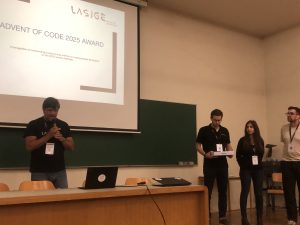
The Executive Committee (Tiago Guerreiro, Cátia Pesquita, Vinicius Cogo and Rúben Gouveia) was pleased to award prizes, at the LASIGE Workshop 2026, to the following top-tier journals and conferences publications:
Žygimantas Jasiūnas, Tiago Julião, José Cecílio, Guilherme Carrilho da Graça, and Pedro M. Ferreira. A soft sensor to assess the energy performance of laundry washing machines. Applied Energy, Volume 383, 2025.
Merve Ekin, Krzysztof Krejtz, Carlos Duarte, Andrew T. Duchowski, and Izabela Krejtz. Prediction of intrinsic and extraneous cognitive load with oculometric and biometric indicators. Scientific Reports, Volume 15, 2025.
José Guilherme de Almeida, Nuno M. Rodrigues, Ana Sofia Castro Verde, Ana Mascarenhas Gaivão, Carlos Bilreiro, Inês Santiago, Joana Ip, Sara Belião, Celso Matos, Sara Silva, Manolis Tsiknakis, Kostantinos Marias, Daniele Regge, and Nikolaos Papanikolaou, On behalf of the ProCAncer-I Consortium. Impact of scanner manufacturer, endorectal coil use, and clinical variables on Deep Learning-assisted prostate cancer classification using multiparametric MRI. Radiology: Artificial Intelligence. Volume 7, Number 3, 2025.
João Mendes, Bernardo Oliveira, Carolina Araújo, Joana Galrão, Nuno C. Garcia, and Nuno Matela. You get the best of both worlds? Integrating deep learning and traditional machine learning for breast cancer risk prediction. Computers in Biology and Medicine, Volume 187, 2025.
José Cecílio, Alan Oliveira de Sá, Georg Jäger, André Souto, and António Casimiro. LWSEE: Lightweight Secured Software-Based Execution Environment. Internet of Things, Volume 30, 2025.
João Mendes, Manuel Piçarra, Inês Gonçalves, André Rodrigues, and João Guerreiro. Exploring aiming techniques for blind people in Virtual Reality. IEEE Transactions on Visualization and Computer Graphics. Volume 31, Issue 5, 2025.
Diogo Furtado, Renato Ribeiro, Manuel Piçarra, Letícia S. Pereira, Carlos Duarte, André Rodrigues, and João Guerreiro. Designing and evaluating a VR boxing experience with blind people. CHI ’25: Proceedings of the 2025 CHI Conference on Human Factors in Computing Systems.
Pedro Trindade, João Guerreiro, and André Rodrigues. Perspectives on mixed-ability competition. CHI ’25: Proceedings of the 2025 CHI Conference on Human Factors in Computing Systems.
Filipa Rocha, Hugo Simão, João Nogueira, Isabel Neto, Tiago Guerreiro, and Hugo Nicolau. Awareness in collaborative mixed-visual ability tangible programming activities. CHI ’25: Proceedings of the 2025 CHI Conference on Human Factors in Computing Systems.
Jing Zhao, Isabel Neto, Ana Cristina Pires, Catarina Tomé-Pires, and Hugo Nicolau. Digital Technologies for Deaf and Hard of Hearing Children: a systematic review, critical reflections, and future research directions. CHI ’25: Proceedings of the 2025 CHI Conference on Human Factors in Computing Systems.
Fernando Gallego, Pedro Ruas, Francisco M. Couto, and Francisco J. Veredas. Enhancing cross-encoders using knowledge graph hierarchy for medical entity linking in zero- and few-shot scenarios. Knowledge-Based Systems, Volume 314, 2025.
Isabel Neto, Isabel Soares, Ana Paiva, and Hugo Nicolau. Investigating crossmodal correspondences between vibrotactile stimuli, colour, and emotions. International Journal of Human-Computer Studies. Volume 197, 2025.
José Cecílio, Tiago Rodrigues, Márcia Barros, and Alan Oliveira de Sá. Leveraging Sustainable Household Energy and Environment Resources Management with time-series. Scientific Data, Volume 12, 2025.
Stefano F. Stefenon, Laio O. Seman, Cristina K. Yamaguchi, Leandro dos S. Coelho, Viviana C. Mariani, João P. Matos-Carvalho, and Valderi R. Q. Leithardt. Neural Hierarchical Interpolation Time Series (NHITS) for reservoir level multi-horizon forecasting in hydroelectric power plants. IEEE Access, Volume 13, 2025.
Joel Samper and Bernardo Ferreira. SoK: Self-generated nudes over private chats: How can technology contribute to a safer sexting?. 2025 IEEE Symposium on Security and Privacy.
Filipa Rocha, David Gonçalves, Ana Cristina Pires, Hugo Nicolau, and Tiago Guerreiro. Exploring collaboration in programming activities with children with visual impairments: a 10-session study in a school setting. Proceedings of the ACM on Human-Computer Interaction, Volume 9, Issue 2, 2025.
Soraia Paulo, Isabel Neto, Nuno Figueiredo, Daniel Lopes, and Hugo Nicolau. Reimagining multidisciplinary teams: Challenges and opportunities for LLMs in cancer MDTs. Proceedings of the ACM on Human-Computer Interaction, Volume 9, Issue 2, 2025.
Miguel A. González-Casado, Andreia Sofia Teixeira, and Angel Sánchez. Evidence of equilibrium dynamics in human social networks evolving in time. Communications Physics, Volume 8, 2025.
Rita Costa, José Coelho, Diogo Lima, Carlos Duarte, and Pedro Moita. ElderWander: an accessible digital tourism platform for older adults. Communications Physics, Volume 8, 2025.
Miguel G. Silva, Sara C. Madeira, and Rui Henriques. Cutting through the noise: Explaining residuals in multivariate time series with motif analysis. Pattern Recognition, Volume 169, 2026.
Diogo F. Soares, Rui Henriques, and Sara C. Madeira. TriHSPAM: Triclustering heterogeneous longitudinal clinical data using sequential patterns. Pattern Recognition, Volume 167, 2025.
Alex Davidson, Amit Deo, and Louis Tremblay Thibault. Pool: A Practical OT-based OPRF from learning with rounding. CCS ’25: Proceedings of the 2025 ACM SIGSAC Conference on Computer and Communications Security.
Hannes Saffrich, Janek Spaderna, Peter Thiemann, and Vasco T. Vasconcelos. Borrowing from session types. Proceedings of the ACM on Programming Languages, Volume 9, Issue OOPSLA2, 2025.
Paulo Canelas, Bradley Schmerl, Alcides Fonseca, and Christopher S. Timperley. ROSpec: A domain-specific language for ROS-Based Robot Software. Proceedings of the ACM on Programming Languages, Volume 9, Issue OOPSLA2, 2025.
Nuno M. Rodrigues, Vanessa F. Fonseca, Renato Mamede, Susanne E. Tanner, Bernardo Duarte, and Sara Silva. Integrating elemental and total reflection X-ray spectral fingerprints with machine learning for advanced seafood traceability. Food Control, Volume 181, 2026.
Nuno M. Rodrigues, José G. Almeida, Ana Castro Verde, Ana Gaivão, Carlos Bireiro, Inês Santiago, Joana Ip, Sara Belião, Celso Matos, Leonardo Vanneschi, Manolis Tsiknakis, Kostas Marias, Daniele Regge, Sara Silva, The ProCAncer-I Consortium, and Nickolas Papanikolaou. Effective reduction of unnecessary biopsies through a deep-learning-assisted aggressive prostate cancer detector. Scientific Reports, Volume 15, 2025.
Sara Silva, Inês Magessi, and Leonardo Vanneschi. Controlling functional complexity for overfitting reduction and improved interpretability in GP. IEEE Transactions on Evolutionary Computation, 2025.
Susana Nunes, Samy Badreddine, and Catia Pesquita. Rewarding explainability in drug repurposing with knowledge graphs. Proceedings of the Thirty-Fourth International Joint Conference on Artificial Intelligence, 2025.
Andreia Sofia Teixeira, Ignacio Echegoyen, Rasha Shanaz, and Alberto Aleta. Dynamics of defensive and malicious worm co-propagation across networked systems. Chaos, Solitons & Fractals, Volume 202, Part 2, 2026.
Claudia Mamede, José Campos, Claire Le Goues, and Rui Abreu. Interpretable vulnerability detection reports. 2025 40th IEEE/ACM International Conference on Automated Software Engineering.
Hugo Figueiras, José Domingues, Nuno Matela, and Nuno Garcia. Self-supervised learning for breast cancer detection: a review. Computers in Biology and MedicineVolume 198, Part B, 2025.
Jéssica Catarino, Nuno C. Garcia, Sara Silva, and João Santinha. The impact of pre-processing techniques on deep learning breast image segmentation. Scientific Reports, Volume 16, 2026.
Tiago Rodrigues, Joana Morgado, Márcia Barros, Alan Oliveira de Sá, and José Cecílio. AI-driven IoT recommender system for enhancing energy efficient management in smart houses. Expert Systems with Applications, Volume 296, Part C, 2026.
Catarina Gamboa, Abigail Reese, Alcides Fonseca, and Jonathan Aldrich. Usability barriers for liquid types. Proceedings of the ACM on Programming Languages, Volume 9, Issue PLDI, 2025.