
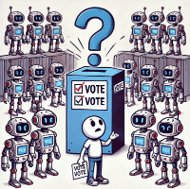
This is a question that our researchers Hugo Simão and João Pedro Pereira, PhD student and MSc student, respectively, and Tiago Guerreiro and Isabel Neto (IR), both integrated members, are seeking to answer at the RobotsVote project, a project that was awarded funding through the competitive LASIGE/FCT Seed Projects Call 2025.
Large language models (LLMs) and robots are becoming part of everyday life, influencing how people access information and make decisions. As their adoption grows, concerns have emerged about their potential impact on human attitudes and beliefs, particularly in political contexts where informed decision-making is essential for a healthy democracy.
We already know that LLMs play an important role in how people access political information. This became especially evident during the 2024 U.S. elections, when LLMs were used in political communication and information dissemination.
While there is growing evidence that LLMs can shape political attitudes, much less is known about the influence of robots in similar contexts. In this work, we investigate whether and how robots may produce different persuasive effects due to their physical embodiment and social presence.
(Image credits: genAI user)