
LASIGE integrated researchers Alan Oliveira de Sá (principal investigator) and José Cecílio, together with Gonçalo Fernandes (MSc student), are developing ASTERICS – Adversarial Strategies for counTERing Intelligent CyberattackS, a project funded through the LASIGE/FCT Seed Projects Call 2025.
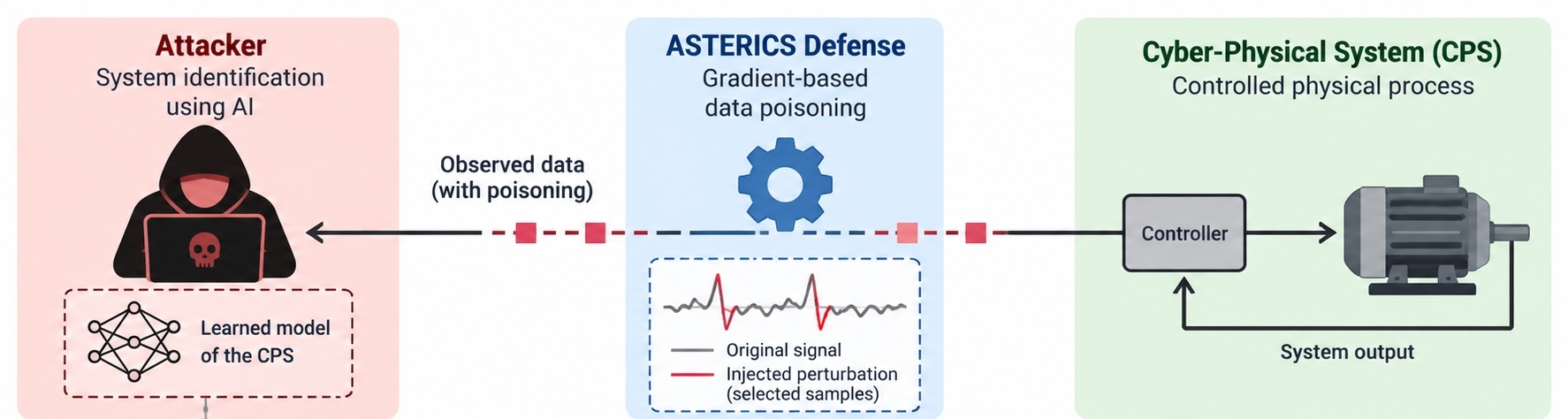
ASTERICS investigates innovative cybersecurity strategies to counter intelligent attacks that leverage Artificial Intelligence (AI) to learn the behaviour of Cyber-Physical Systems (CPS) and conduct stealthy malicious actions. The project explores Adversarial Machine Learning (AML) as a defensive mechanism, using data poisoning techniques to disrupt attackers’ learning processes and compromise their ability to execute covert attacks.
Preliminary results, obtained in collaboration with Victor Mattos, Daniel S. Menasché, and Amit Bhaya from the Federal University of Rio de Janeiro (UFRJ), will be presented in the paper “Gradient-Based Defensive Poisoning Against System Identification Attacks on Cyber-Physical Systems” at IEEE TechDefense 2026, taking place on November 4–6, 2026, in Turin, Italy. The proposed technique introduces carefully designed, gradient-based perturbations into the data observed by attackers, targeting the most influential samples to degrade the accuracy of their learned models. Experiments in a simulated DC motor control system demonstrate its effectiveness compared to conventional noise-based approaches, with promising results across different system identification methods.
ASTERICS contributes to advancing cybersecurity research by exploring how adversarial AI can be repurposed to defend industrial systems and critical infrastructures.