
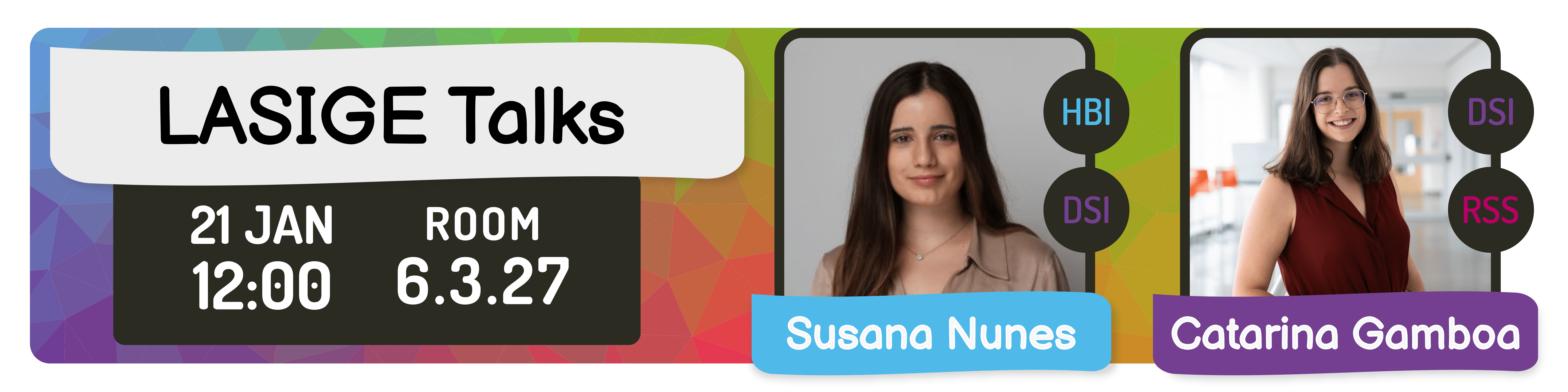
LASIGE Talks are fortnightly/monthly events to publicize recently distinguished publications or ongoing cutting-edge work by researchers from the research centre, consolidating the scientific culture of the LASIGE community.
Speakers: Catarina Gamboa and Susana Nunes
Date: January 21st, 2026, Wednesday, 12:00
Where: C6.3.27
12:00 Talk by Catarina Gamboa
12:20 Talk by Susana Nunes
12:40 Q&A + Break for snacks & coffee
Title1: Usability Barriers for Liquid Types
Speaker: Catarina Gamboa
Abstract: Liquid types can express richer verification properties than simple type systems. However, despite their advantages, liquid types have yet to achieve widespread adoption. To understand why, we conducted a study analyzing developers’ challenges with liquid types, focusing on LiquidHaskell. Our findings reveal nine key barriers that span three categories, including developer experience, scalability challenges with complex and large codebases, and understanding the verification process. Together, these obstacles provide a comprehensive view of the usability challenges to the broader adoption of liquid types and offer insights that can inform the current and future design and implementation of liquid type systems.
Paper: https://dl.acm.org/doi/10.1145/3729327
Title2: Rewarding Explainability in Drug Repurposing with Knowledge Graphs
Speaker: Susana Nunes
Abstract: Knowledge graphs (KGs) are powerful tools for modelling complex, multi-relational data and supporting hypothesis generation, particularly in applications such as drug repurposing. However, for predictive methods to be accepted as credible scientific tools, they must provide not only accurate results but also meaningful scientific explanations.
This talk presents REx, a novel approach for generating scientific explanations for link prediction in knowledge graphs. REx uses reward and policy mechanisms that capture desirable properties of scientific explanations to guide a reinforcement learning agent in identifying explanatory paths. These paths are further enriched with domain-specific ontologies, ensuring explanations are both insightful and grounded in established biomedical knowledge.
Paper: https://www.ijcai.org/proceedings/2025/0515.pdf