
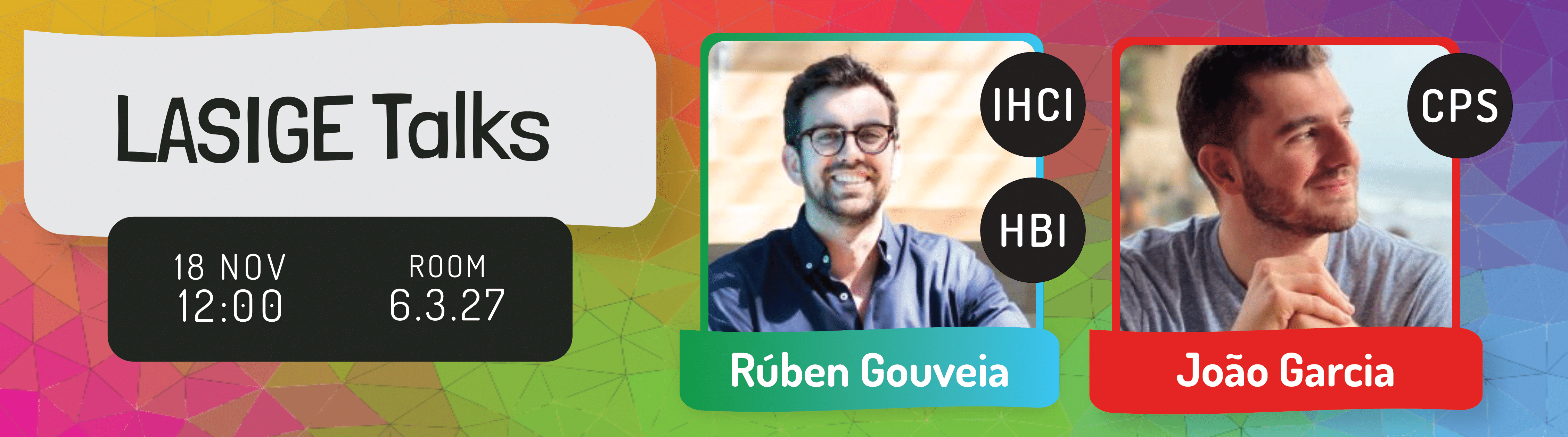
LASIGE Talks are fortnightly/monthly events to publicize recently distinguished publications or ongoing cutting-edge work by researchers from the research centre, consolidating the scientific culture of the LASIGE community.
Speakers: Rúben Gouveia and João Garcia
Date: November 18th, 2026, Wednesday, 12:00
Where: C6.3.27
12:00 Talk by Rúben Gouveia
12:20 Talk by João Garcia
12:40 Q&A + Break for snacks & coffee
Talk1: Micro Goals, Everyday Action: Rethinking Behaviour Change Technologies
Speaker: Rúben Gouveia
Publication: https://dl.acm.org/doi/full/10.1145/3772318.3791066
Summary: Digital health and behavior change technologies often rely on fixed daily goals that struggle to accommodate the unpredictability of everyday life. As schedules fluctuate and opportunities for action vary, these goals can become sources of frustration rather than motivation. In this talk, I explore micro-goals: brief, situated goals designed to fit into everyday routines. Drawing on a 27-day field study of Mikro, a smartwatch app used by 16 participants, I show how micro-goals encouraged people to tailor their goals, take immediate action, and seize small opportunities for movement. I discuss how these findings can inform more flexible behavior change technologies.
Talk2: SHIVED-IoT – Decentralized Architecture for Ensuring Trust and Secure Handoffs in Dynamic IoT Networks
Speaker: João Garcia
Publication: https://www.sciencedirect.com/science/article/pii/S0167404826002397
Summary: Mobile IoT devices such as connected vehicles keep switching edge servers, often run by different operators. Each switch forces a new handshake on a constrained device, and any of those edges may be compromised and silently alter, delay, or drop data. We present SHIVED-IoT, an architecture that combines secure handover with continuous integrity verification. Session keys move between edges through a decentralized coordination layer, so devices skip renegotiation, while edges must keep proving they run the expected logic, with public, attributable verdicts. We evaluate two coordination backends: BFT-SMaRt is faster, while an EVM blockchain offers independent auditability.