
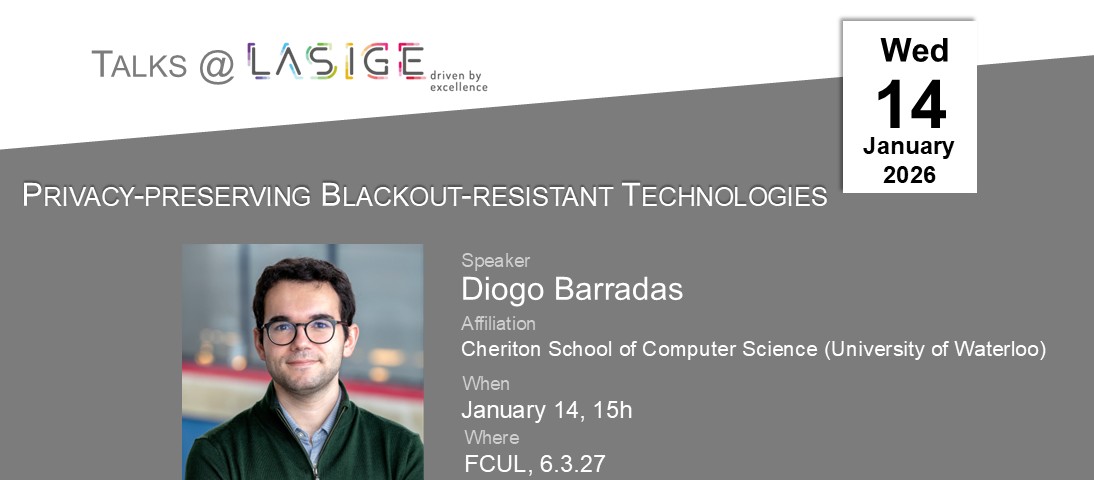
Title: Privacy-preserving Blackout-resistant Technologies
Speaker: Diogo Barradas (Cheriton School of Computer Science, University of Waterloo)
Date: January 14, 2026, 15h00
Where: C6.3.27
Invited by: Bernardo Ferreira (LASIGE/FCUL)
(coffee break included)
Abstract: Internet shutdowns (or blackouts) disrupt access to online services, whether triggered by disasters, technical failures, or repressive governments’ activity. In 2024 alone, 296 blackouts were recorded across 54 countries. To counter state-imposed blackouts, citizens often rely on blackout-resistant apps — deployed as mesh networks running on mobile devices — to restore communication and facilitate coordination. However, existing solutions support only a narrow set of uses cases and fail to provide anonymous trust formation among users and to conceal the usage of the app itself. These gaps restrict the practical deployment of such tools and jeopardize citizens’ safety by exposing them to prosecution or other forms of retaliation. In this talk, I will outline our past and ongoing work on improving the privacy and safety of blackout-resistant communication technologies and discuss new use cases that extend these apps’ capabilities.
Bio: As of 2022, Diogo is an Assistant Professor at the Cheriton School of Computer Science at the University of Waterloo, and a member of the CrySP group. He also serves as the Associate Director of the Waterloo Cybersecurity and Privacy Institute (CPI) since March 2024. His track record counts with over 30 peer-reviewed publications, several of which included in top venues for computer and communications security (IEEE S&P, ACM CCS, USENIX Security, NDSS), as well as PETS, the world’s premier forum dedicated to computer privacy. In 2025, Diogo has been awarded with a FOCI Rising Star Award for his continued work in the field of internet freedom. Previously, he completed his PhD on Information Systems and Computer Engineering at Instituto Superior Técnico (IST) – Universidade de Lisboa, while also having the chance to undertake a research internship at Carnegie Mellon University. In late 2021, he completed a post-doc at Rice University.