
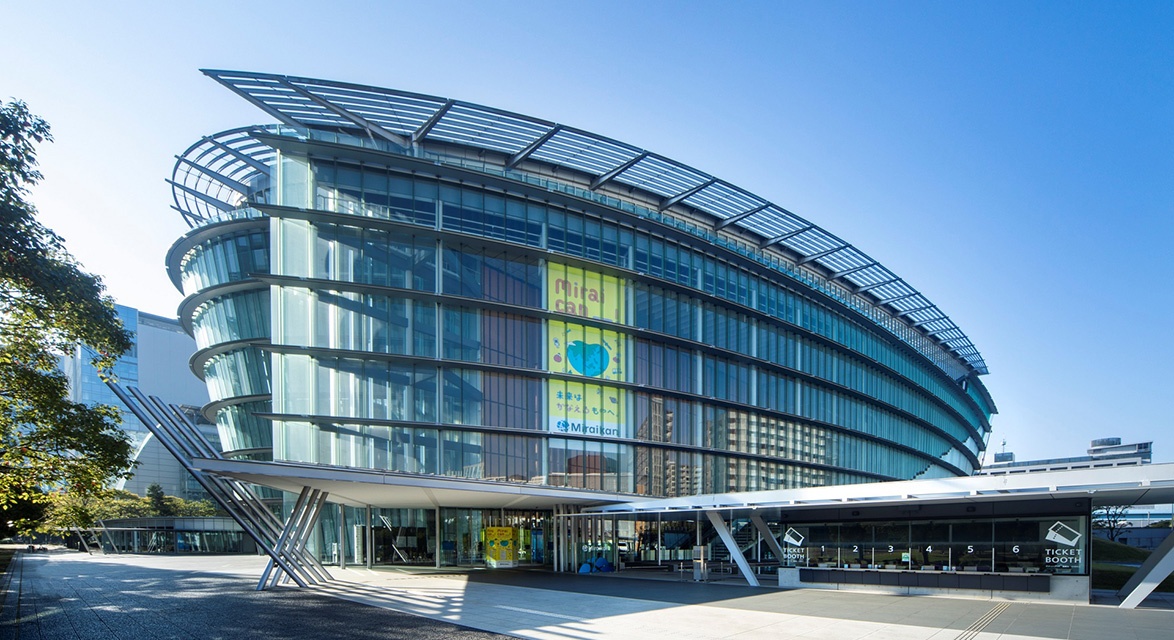
LASIGE integrated researcher João Guerreiro spent two months at Miraikan – The National Museum of Emerging Science and Innovation, in Tokyo, Japan, as part of his sabbatical period. The research visit focused on advancing research on accessible interaction for blind and low vision people in collaboration with Chieko Asakawa.
The visit built on shared research interests in supporting the independent navigation and exploration of complex spaces by blind people, while also investigating how virtual elements and digital information can be made accessible when integrated into physical environments. Miraikan provided a particularly rich setting for this work, combining an active research environment with a real-world museum context where new approaches to navigation, spatial interaction, and exhibit access can be explored.
During the stay, Guerreiro worked closely with Chieko Asakawa and her team at Miraikan’s Accessibility Lab, as well as with researchers from partner institutions. These collaborations included Renato Ribeiro, a former LASIGE member who is now a researcher at Miraikan.
These collaborations led to several research activities around non-visual spatial interaction, accessible virtual environments, wearable cameras, and museum accessibility. Two of the works developed through these collaborations were accepted at ACM ASSETS 2026 – the ACM SIGACCESS Conference on Computers and Accessibility, a leading international venue for accessibility research and a CORE A-ranked conference.
The first, “Designing for Ring Camera Use: Spatial Interaction Strategies of Blind and Low Vision People,” investigates how blind and low vision people interact with information using a finger-worn camera. The work examines how users coordinate their hands and bodies when exploring different types of museum content, showing, among other strategies, how the non-camera hand can serve as a spatial anchor while the camera-wearing hand moves through space.
The second paper, “From Coarse Search to Precise Alignment: Auditory Guidance for Non-Visual Target Acquisition in VR,” explores how auditory feedback can support blind people in finding and accurately reaching virtual targets in 3D spaces. The study investigates how different forms of auditory guidance can support different stages of the interaction, from initially locating a target to making finer corrections as one approaches it.
Beyond these two publications, the research stay also contributed to other work currently under review and to ongoing collaborations that will continue beyond the mobility period. This research visit (Feb.-March) was supported by the FCT Mobility programme.