
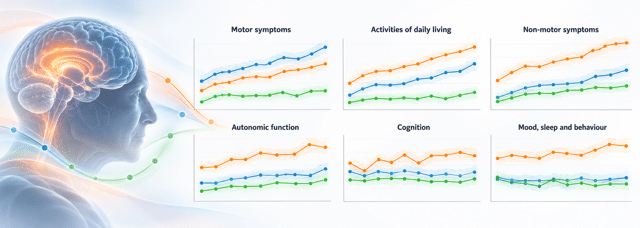
Parkinson’s disease does not progress in the same way for every patient. This variability remains one of the major challenges in understanding the disease and anticipating how an individual patient may progress.
The ParkProfile project, led by Diogo F. Soares, is addressing this challenge by developing advanced artificial intelligence methods to identify and predict different patterns of disease progression. The project focuses on longitudinal and multimodal patient stratification, moving beyond traditional analyses based on measurements collected at a single point in time. The LASIGE team also includes the MSc Students Diogo Barreta and Sebastião Cancela, and the integrated researchers Helena Aidos, Sara C. Madeira, and Tiago Guerreiro.
Recent work by Diogo Barreta, based on 1,002 patients, 8,801 clinical visits, and 327 longitudinal variables, revealed three distinct candidate progression profiles: one dominated by motor deterioration, another characterized by faster progression across multiple clinical dimensions, and a third showing comparatively mild and slower progression.
Complementing this work, Sebastião Cancela is exploring the integration of multiple data modalities to develop multiclass predictive models that stratify patients according to their risk of reaching critical disease endpoints within specific time windows. Together, these complementary approaches aim not only to understand how different Parkinson’s profiles evolve, but also to anticipate clinically relevant outcomes.
The findings highlight that Parkinson’s progression may not follow a single path from mild to severe. Instead, different dimensions of the disease can evolve along distinct trajectories, reinforcing the importance of patient stratification and prediction for more personalized prognosis, monitoring, and treatment.
The project has clinical validation from neurologists at CNS-Campus Neurologico Sénior. This project was awarded funding through the competitive LASIGE/FCT Seed Projects Call 2025.