
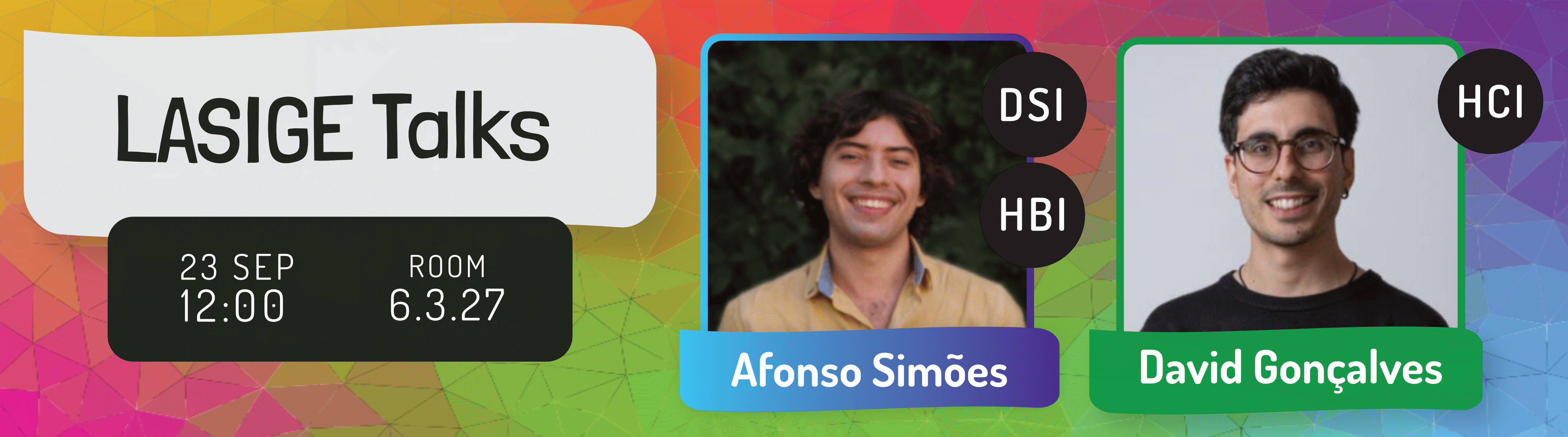
LASIGE Talks are fortnightly/monthly events to publicize recently distinguished publications or ongoing cutting-edge work by researchers from the research centre, consolidating the scientific culture of the LASIGE community.
Speakers: David Gonçalves and Afonso Simões
Date: September 23rd, 2026, Wednesday, 12:00
Where: C6.3.27
12:00 Talk by David Gonçalves
12:20 Talk by Afonso Simões
12:40 Q&A + Break for snacks & coffee
Talk1: Modular Multiplayer: Segmenting Gameplay to Enable Catered Multiplayer Experiences
Speaker: David Gonçalves
Summary: Over the past seven years, my research has been exploring how one can intentionally introduce asymmetries in multiplayer gaming to tailor the experience to diverse abilities (e.g., sighted and blind players), preferences, and availability. In this talk, I present “modular multiplayer”, a design approach to build shared experiences through gameplay modules tailored to specific player constraints. Grounded in two recently published studies, I will discuss key design considerations for this approach, including strategies for preserving social connection when decoupling fundamental aspects of multiplayer games (e.g., a shared game world).
Publications: https://techandpeople.github.io/downloads/2026_cscw_modular.pdf & https://techandpeople.github.io/downloads/2026_chiplay_worldgoal.pdf
Talk2: Generative Modelling of Longitudinal Brain Tumor MRI for Treatment-related changes assessment
Speaker: Afonso Simões
Summary: After chemoradiation, glioblastoma often shows new enhancing areas that mimic tumour growth but are treatment-related. Imaging cannot tell the two apart at a single visit, and the criteria resolve the question only across successive scans, so the diagnosis waits months, during which therapy may be wrongly continued or withdrawn. We address this by predicting the next acquisition, modelling the post-treatment course as a transport between two distributions separated by time, with flow matching and Schrodinger bridges. The predicted follow-up improves discrimination on an external cohort, yet the settings that discriminate best are not those with the best fidelity metrics.
Related publication: https://www.sciencedirect.com/science/article/pii/S0933365726000448