
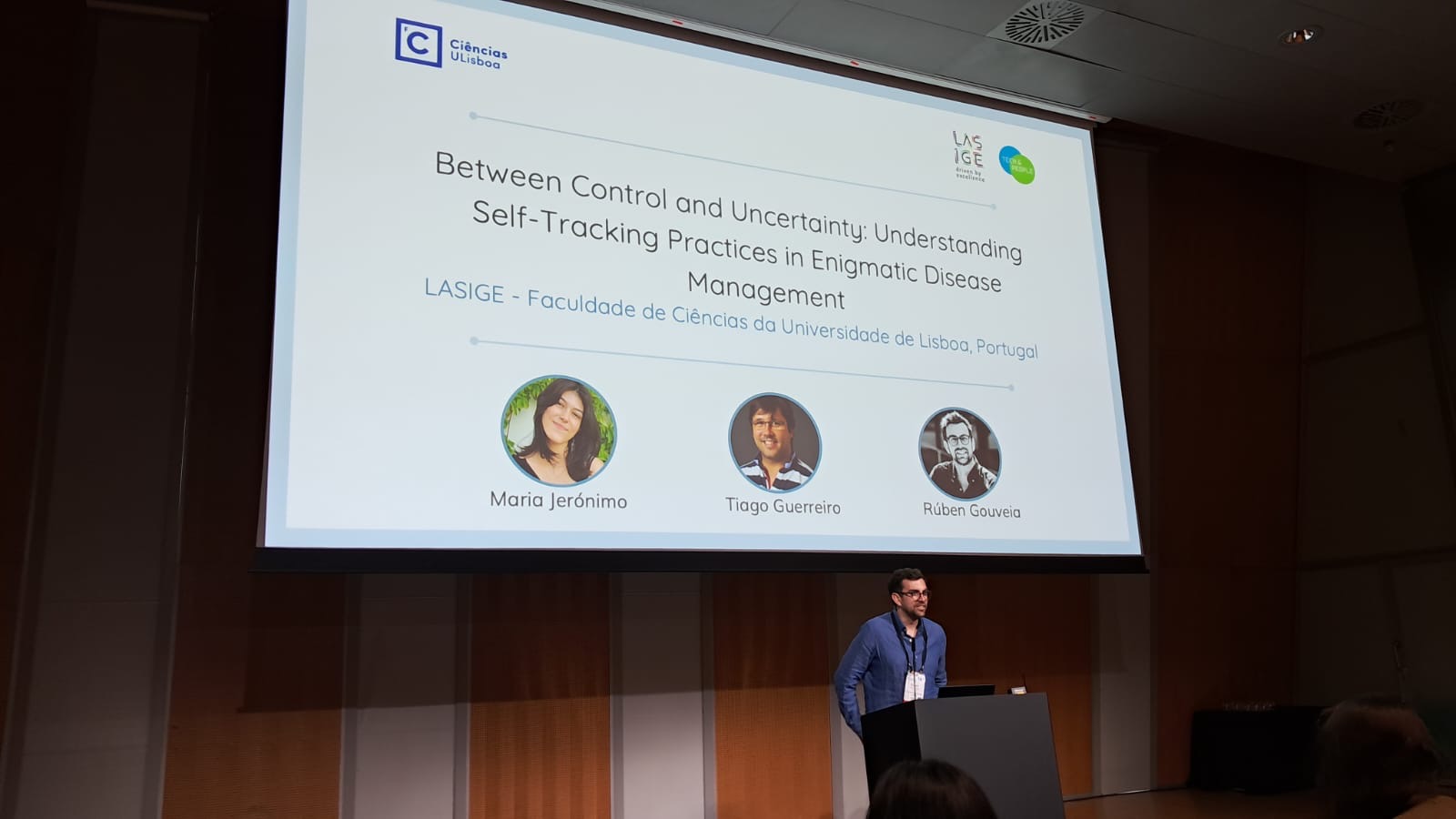
The paper “Between Control and Uncertainty: Understanding Self-Tracking Practices in Enigmatic Disease Management”, authored by LASIGE’s MSc student Maria Jerónimo and integrated researchers Tiago Guerreiro and Ruben Gouveia, explores how people living with poorly understood and highly individualised chronic conditions use self-tracking to manage the uncertainty and fluctuations associated with their illnesses.
While self-tracking tools are often designed around the assumption that collecting the “right” health data will generate useful insights and a greater sense of control, this assumption becomes more problematic for enigmatic diseases such as fibromyalgia, Crohn’s disease, and endometriosis, where symptoms can vary considerably between individuals and fluctuate unpredictably over time. The authors therefore shift the focus from what people track to when and why they track, investigating how tracking changes across different states of illness.
The findings reveal a fundamental tension in self-tracking. On one hand, tracking can provide a sense of agency and control by helping people understand their bodies, prepare for flare-ups, communicate more effectively with healthcare professionals, and make informed decisions. On the other hand, when tracking fails to reveal consistent patterns or actionable explanations, it can increase frustration, uncertainty, guilt, and self-blame. The authors therefore characterise tracking as a “double-edged” practice, in which the pursuit of control can sometimes reinforce the realisation that the illness remains beyond the individual’s control.
The work highlights the need to move beyond static, disease-specific tracking systems toward tools that can adapt to changing symptoms, goals, and circumstances. In particular, the authors propose a layered approach, combining a shared core for common experiences such as symptom fluctuations and uncertainty with optional condition-specific modules. Such an approach could better accommodate people with multiple or changing diagnoses without forcing them to manage their conditions through fragmented, disease-specific tools.
The paper was presented at the CHI 2026 conference in Barcelona, Spain, held from April 13 to 17, 2026, and is available here.